To Contact Us
November 2002 Edition----Previous Edition here
Home PageItems This Month
Let us start with Corporate Transparency the new initiative from the Institute of Chartered Accountants of New Zealand. They put out this paper a month or two back as a response to corporate scandals in the US and the decline in market values there. It discusses possible rule changes in New Zealand as a result. It concludes with a case study on Enron. It is a pity they could not see fit to highlight a few of the 160 odd complaints against their members which they received in the past year instead, but these remain top secret. The theme of the paper seemed to be that lack of confidence in accounting standards should not be allowed to affect market price levels. Not a very high level to set ones sights to one would think. They are concerned with the macro but not the micro situation. Tough luck to individual victims of bad accounting.
The Institute has now posted a selection of submissions in response to its paper. It includes some critical ones, surprise, surprise. They can be accessed from here.
The KPMG submitter to be fair makes the good point that the Institute has been educating on the limitations of Auditing for so long that the public no longer see it as a worthwhile function. When something goes wrong it is not PC to ask "why didn't the auditors catch up with it?". Like divining for underground water, auditing is a science that has had its day because nobody believes in it any more. External auditors still exist and are compulsory for public companies and the like but they are now coming under the wing of an Audit Committee of the Board of Directors instead of being appointed by the shareholders and directly accountable to them. They are starting to be seen in the same light as internal auditors, a precursor to the amalgamation of the two functions perhaps. It is a pity because the independent audit function has much to offer the community if auditors who allowed themselves to be bought were punished. The 1990 BNZ annual accounts are a case in point. The media just accepted the problem was beyond the ability of the auditors to put things right which was not so.
Two submissions from the University of Canterbury staff, Robb and Newberry are among others both very critical of the Corporate Transparency document. One documents accounting failure in New Zealand, which the Institute does its best to hide, and the other gives the appearance of an academic treatment, concluding that the report is inconsistent with the code of ethics and should be abandoned.
 Mr Allen is an Ernst and Young audit partner, currently contracted to the Auditor General to do the Accident Compensation Corporation audit. He is a past president of the Institute of Chartered Accountants of NZ (or its predecessor) and for several years has been chair of the Education Committee of the International Federation of Accountants. He received an Outstanding Contribution award from the Institute in 2001. It is great what one can achieve when there are scandals needing to be covered up. Mr Allen was a partner in Ernst and Whinney up until early 1988. At the time of his leaving there this firm was auditor of the Bank of New Zealand. After a time in the management of DFC, formally the government owned Development Finance Corporation which had been partially privatised and then went into receivership, Mr Allen joined Ernst and Young in July 1990, little more than a month after that firm signed an audit report purporting to have audited the 1990 annual accounts of the Bank of New Zealand. Aspects of these accounts and their purported audit are to be found extensively on this site. Conveniently Mr Allen had been absent from the auditing firm during the period when a bogus insurance scheme and another long term zero coupon bond scheme were established by the BNZ in March 1988 and when these schemes were utilised to over-report profit in May 1990.
On page 3 of a letter to the Institute of Chartered Accountants of NZ which can be accessed here Mr Allen at item g says he understands that this unqualified 1990 audit report has never been deemed inappropriate and "The Securities Commission confirmed this after an extensive enquiry". Clearly he is asserting that the Securities Commission did not deem the unqualified audit report to be inappropriate which is not correct. The relevant statement of the Commission's findings are to be found here. It is submitted that such a misstatement by Mr Allen is not excusable. He was still a partner of Ernst and Young in 1992 and 1993 (and remains so) when rather unprecedented allegations were made concerning BNZ reporting and the role of the auditors, leading to the Securities Commission enquiry and publicity with its release. It is inconceivable that Mr Allen did not take an interest in it since his office and partners were involved. It is submitted that his intention was to mislead. This is not ancient history but a statement made this year- 2002.
In the years following the 1993 "Report of an Enquiry into certain arrangements entered into by Bank of New Zealand in March 1988" of the Securities Commission Mr Allen has been the prime instigator in beefing up educational requirements for entry to and continuing effective membership of the ICANZ. While there are not any exams for exiting members to pass the costs of membership in terms of money and time has increased substantially. Although this education is compulsory the enforcement of it has been very tardy. Honest members who have felt that they could not meet the requirements have been obliged to resign while those who just ignore the requirements survive. They have paid the price for the wilfully unjustified 1990 Audit report of Mr Allen's collegues. It is a case of making other innocent people suffer for ones colleagues cooking of the books at the BNZ.
We turn now to one of two new life members of the Institute of Chartered Accountants of NZ. 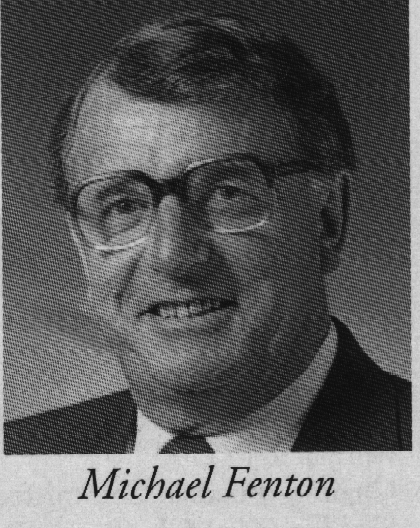 Michael Fenton is a long time chairman of the Institute's committee which handles complaints against members. The public is given no appeal rights against the rulings of this committe. Mr Fenton was chairman of this committe in 1993 when it dismissed complaints against all members of of what was then the NZ Society of Accountants who had participated in instigating or upholding the bogus insurance policy and other misallocations of income from zero coupon bonds, by which the Bank of New Zealand justified a gross over-statement of its 1990 profit. The committee expressed no criticism of the members concerned.
It would seem that in 1988 Mr Fenton was a partner in the firm KPMG Peat Marwick. This firm would appear to have advised in 1988 that the bogus insurance scheme was valid and in particular that cash from the "policy" which would be received several year's hence could offset current bad debts at face value. The cash was going to be received regardless of whether or not "claims" were made. This apparent advice is contained in the Securities Commission report at page 79 as follows:
Michael Fenton is a long time chairman of the Institute's committee which handles complaints against members. The public is given no appeal rights against the rulings of this committe. Mr Fenton was chairman of this committe in 1993 when it dismissed complaints against all members of of what was then the NZ Society of Accountants who had participated in instigating or upholding the bogus insurance policy and other misallocations of income from zero coupon bonds, by which the Bank of New Zealand justified a gross over-statement of its 1990 profit. The committee expressed no criticism of the members concerned.
It would seem that in 1988 Mr Fenton was a partner in the firm KPMG Peat Marwick. This firm would appear to have advised in 1988 that the bogus insurance scheme was valid and in particular that cash from the "policy" which would be received several year's hence could offset current bad debts at face value. The cash was going to be received regardless of whether or not "claims" were made. This apparent advice is contained in the Securities Commission report at page 79 as follows:
Peters also tabled letters and memoranda prepared within the EP group. These included a letter of 24 February 1988 from Jones, an executive of the EP group, to the Bank. Jones stated that:
We have discussed with KPMG Peat Marwick the accounting implications of the transaction. It is our understanding that the existence of the insurance policy will enable Bank of New Zealand to receive, in respect of the loans insured, not less than the amount provided for in the policy and thus the value of the assets insured by the policy. Notwithstanding that payment is not made until the end of the policy, as the Bank can, because of the security outlined [above] be certain of the recovery of the principal amount it need not write down the debts as doubtful debts. In KPMG Peat Marwick's view the application of appropriate accounting principles will result in the accounting treatment we have discussed. We understand you will have to obtain separate advice from Ernst and Whinney on these aspects.
There is no record of Mr Fenton having declared an interest in the matter.
Books
New case studies of ICANZ coverups 2 Ernst and Young report to Dairy Co shareholders
Pokemon
Gifts
Cars
Toys
MP3
Videos
Dolls
Garden tools
Jewelry
------------------------
Structure and Operation of an alternative Accounting Organisation designed to shun dishonesty.
Suitable Objectives
Register of Members
Members Forum - Topical
 - open to all meantime:
 Plenty of Opinion
Magazine Plans
Need an Accountant?
 or Prepared to Change?
Users Forum
 - have your say
Ready to Join?Offering some Help?
Knowledge Tests
 - being developed
Information Bulletins
Why it is being Proposed
What's Wrong with
 the existing
 accounting body?
So called BNZ Auditan extensive case study Current Attitudes of Existing Institute
 Visit our Advertising
 page from Here